01 · Foundation
Email Structure in Chinese
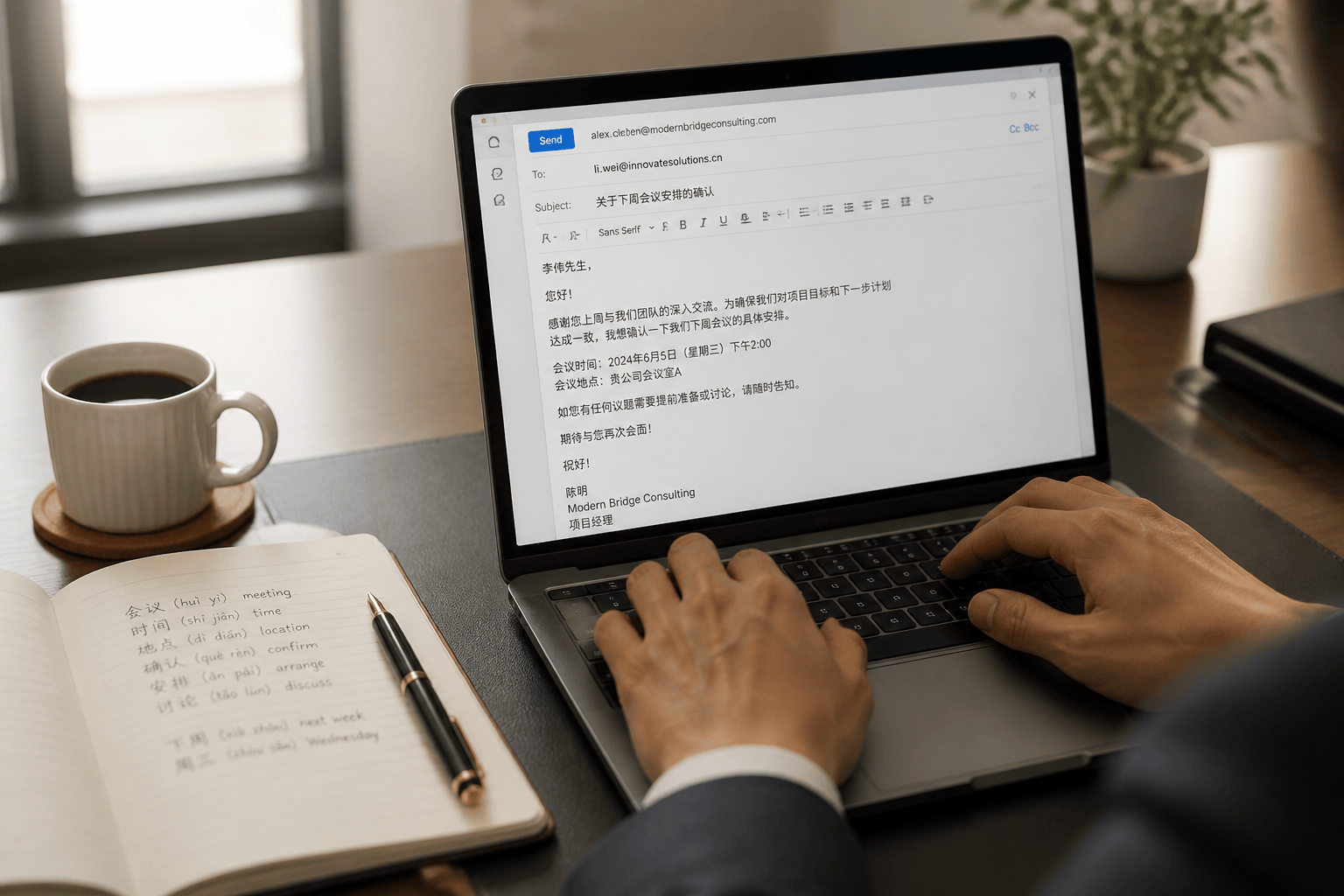
A professional Chinese email is easier to read when every part has a clear job. Keep the message concise and make the requested action visible.
Subject line
State the purpose and topic directly, such as 关于项目进度的确认 (confirmation regarding project progress).
Greeting
Use 您好 for a neutral professional opening or 尊敬的李经理 for a formal relationship.
Body
Open with context, give the key details in short paragraphs or bullets, then make one clear request.
Closing
End with a next step and a courteous sign-off such as 期待您的回复 or 祝工作顺利.
02 · Phrase bank
50 Business Chinese Email Phrases by Category
Learn reusable expressions in context. Replace the ellipses with your project, date, document, or request.
Subject lines
- 关于...的确认 — Confirmation regarding...
- ...会议纪要 — Meeting minutes for...
- 关于报价的咨询 — Inquiry about a quotation
- 项目进度更新 — Project progress update
- 合同条款讨论 — Contract terms discussion
Greetings
- 您好 — Hello
- 尊敬的... — Respectful...
- 李经理,您好 — Hello, Manager Li
- 各位同事,大家好 — Hello, colleagues
- 感谢您抽出时间 — Thank you for your time
Openings and context
- 希望您一切顺利 — Hope you are doing well
- 关于我们上次讨论的... — Regarding our last discussion...
- 感谢您之前的回复 — Thank you for your earlier reply
- 根据我们的沟通 — Based on our communication
- 现将...发送给您 — I am sending ... to you
Requests and follow-ups
- 能否请您... — Could you please...
- 麻烦您... — Would you trouble yourself to...
- 烦请确认 — Kindly confirm
- 如有任何问题,请随时联系我 — Please contact me with any questions
- 期待您的回复 — Looking forward to your reply
Expand these core phrases with polite transitions, dates, attachments, clarification requests, and closing options to build a complete 50-phrase working bank.
03 · Templates
Five Email Templates to Adapt
Introduction email
您好,我是[姓名],来自[公司]。很高兴与您联系。我们希望就[topic]与贵公司展开合作,期待进一步沟通。
Follow-up email
您好,跟进之前的邮件,想请问您是否有时间确认[request]?如需补充信息,请随时告诉我。
Request email
您好,能否请您在[date]前提供[document/information]?这将帮助我们完成下一步安排。
Thank-you email
感谢您今天的时间和详细介绍。我们会认真评估相关信息,并在[date]前回复您。
Apology email
很抱歉给您带来不便。我们正在处理[issue],预计在[date]前完成,并及时向您更新进展。
04 · Practical tips
Write Clearer, More Polite Emails
Be clear and concise
Put the purpose in the first paragraph and separate multiple requests.
Use appropriate formality
Choose 您, 请, and 麻烦您 when the relationship calls for respectful language.
Check before sending
Verify names, dates, numbers, attachments, and the recipient list.
Follow email etiquette
Reply promptly, acknowledge the request, and give a realistic next step.
Turn phrases into confident communication
Practice writing with realistic prompts and get feedback on clarity, tone, and cultural fit.
Continue learning
FAQ: Business Chinese email phrases
How do I write business emails in Chinese?
Use a clear subject line, a respectful greeting, a concise purpose, organized details, and a polite closing. Match the formality to the relationship and check names, dates, and attachments before sending.
What are common Chinese email phrases?
Useful phrases include 关于...的确认 (confirmation regarding...), 希望您一切顺利 (hope you are doing well), 能否请您... (could you please...), and 期待您的回复 (looking forward to your reply).
How formal should my Chinese business emails be?
Default to a professional, respectful tone with 您, 请, and 期待您的回复. You can become more conversational only after the relationship and context make that appropriate.
How do I follow up politely in Chinese?
Refer briefly to the earlier message, state what you need, and give the recipient an easy next step. For example: 跟进之前的邮件,想请问您是否有时间确认? (Following up on my previous email, may I ask if you have had time to confirm?)