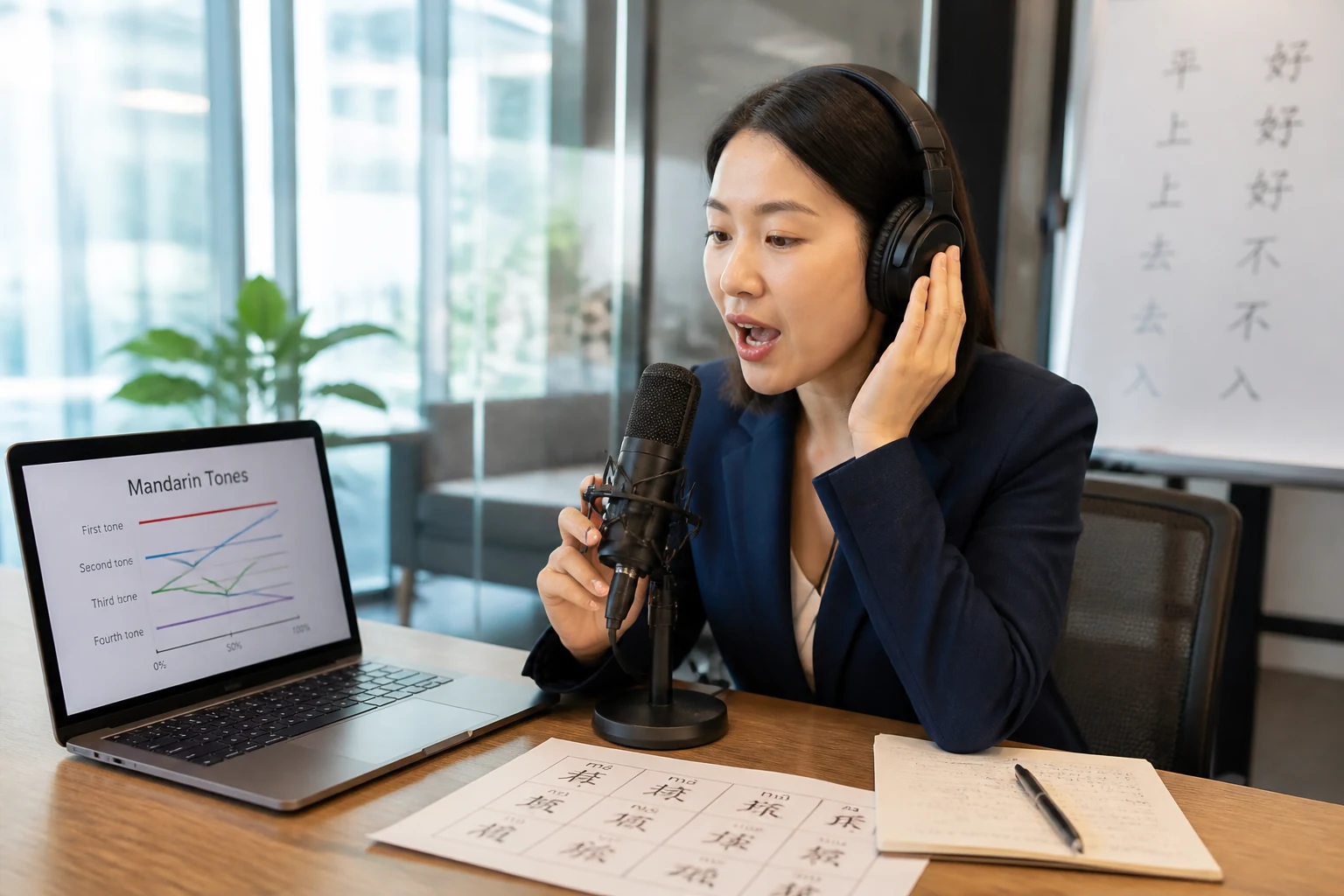
Business Chinese pronunciation is where most learners quietly hit a wall. You can read a contract, build a sentence, and know exactly which word you want — and still watch a supplier frown, a client ask you to repeat yourself, or a negotiation stall because one syllable came out on the wrong tone. In Chinese, pronunciation is not decoration on top of meaning; it is part of the meaning.
That changes what "good enough" looks like. You do not need a native accent to succeed in business Chinese, and chasing one wastes time you could spend on clarity. What you do need is to be understood the first time — to make 买 (mǎi — to buy) sound like 买 and not 卖 (mài — to sell), to keep 十四 (shísì — fourteen) from drifting into 四十 (sìshí — forty) when you quote a unit price, and to deliver 贵公司 (guì gōngsī — your honorable company) with the courtesy it was meant to carry. Pronunciation that is clear and consistent reads as competence and preparation; pronunciation that is not invites doubt about everything else you say.
This guide covers four things. First, why pronunciation carries so much weight in business settings — the cost of a wrong tone, how clarity builds trust, and the professional impression your delivery creates before your words are even processed. Second, the specific challenges that trip up English speakers: the four tones and the meanings they separate, the sounds that do not exist in English, and the way real speech connects and shifts those sounds. Third, the practice methods that actually move the needle, including tone drills with real business words, the shadow technique with native audio, self-recording and review, and AI feedback that flags the exact syllable you missed. Finally, the pronunciation you need for the concrete things business requires — company names, industry terms, numbers and prices, and the standard phrases you say dozens of times.
By the end you will know which sounds to fix first, how to drill them, and how to hear yourself the way a Chinese-speaking counterpart does. And you will have a way to practice out loud without a partner, a classroom, or the fear of saying the wrong thing in front of a client. Pronunciation is the base layer of business Chinese speaking practice; if you are starting from zero, work through business Chinese for beginners first, then come back to the drills here. Ready to hear the difference a clean tone makes? Start Tone Training and run your first drill in the next five minutes.
Why Pronunciation Matters in Business
In casual conversation, a mispronounced word usually costs you a moment. In business, it can cost you the deal. Pronunciation sits underneath every commercial exchange, and three consequences repeat often enough to treat as rules.
A wrong tone is a different word
Mandarin uses pitch to distinguish words, so a single tone error hands your listener a completely different meaning — often with no context to rescue it. These pairs are the ones that matter most in business:
Pinyin: Zhè pī huò wǒmen xiǎng mǎi.
English: We would like to buy this batch of goods.
Use it for: Stating your side of a transaction. 买 (mǎi — to buy) is third tone; say it as 卖 (mài — to sell, fourth tone) and you have just announced the opposite of your intention.
Pinyin: Qǐngwèn, dānjià shì duōshao?
English: May I ask, what is the unit price?
Use it for: The polite opening of any price question. 问 (wèn — to ask, fourth tone) collapses into 吻 (wěn — to kiss, third tone) if you soften the tone, turning a professional enquiry into an awkward proposition.
Pinyin: Qǐng zài zhèlǐ qiānzì.
English: Please sign here.
Use it for: Closing a contract. 签 (qiān — to sign) is first tone; 钱 (qián — money) is second tone. Land between the two and 签字 (qiānzì — to sign) starts to sound like money talk at the wrong moment.
The lesson is not "never make a mistake." It is that some syllables carry a commercial decision, so those are the ones to over-learn first.
Clarity builds trust
A counterpart who has to ask you to repeat yourself is spending attention on decoding you instead of on your offer. That friction compounds. On a call with a poor line, on a factory floor with background noise, or across a table with three people talking, clear pronunciation is the difference between being followed and being skipped. Clear speakers get asked follow-up questions; unclear speakers get polite nods and no follow-up. In a relationship-driven market, being easy to understand is itself a form of respect — it signals that you took the other person's effort seriously.
Pronunciation creates a professional impression
People form a judgment about your competence, preparation, and seniority within seconds of hearing you speak, and much of that judgment is about delivery rather than vocabulary. Crisp tones, steady rhythm, and confident volume read as "this person knows their business." Mumbled, drifting tones read as uncertainty — even when the sentence is grammatically perfect. The good news is that a small, targeted improvement pays off disproportionately: a handful of cleaned-up sounds and consistent tones can change how you are perceived far more than adding another hundred words to your vocabulary.
The takeaway: treat pronunciation as a business skill, not an accent project. Fix the syllables that change meaning, stay clear under pressure, and let consistent delivery carry the professional signal for you.
Key Pronunciation Challenges
Most English speakers hit the same three walls: the tone system, a set of sounds English does not use, and the way those sounds transform once they are strung together in real speech. Understanding each one lets you practice deliberately instead of hoping it improves on its own.
The four tones and what they separate
Mandarin has four tones plus a light neutral tone, and each tone is a fixed pitch contour rather than an emotional cue. The table below gives the shape and a business-relevant word for each.
| Tone | Contour | Mark | Business example | Meaning |
|---|---|---|---|---|
| First | High and flat | ˉ | 商 (shāng) | commerce; 公司 (gōngsī — company) |
| Second | Rising | ˊ | 钱 (qián) | money |
| Third | Falling then rising | ˇ | 买 (mǎi) | to buy |
| Fourth | Falling sharply | ˋ | 卖 (mài) | to sell |
A single word shows how much the tone carries:
Pinyin: Wǒ yào mài, nín yào mǎi, duì ma?
English: I want to sell, you want to buy, right?
Use it for: Confirming the direction of a deal. 卖 (mài — to sell) and 买 (mǎi — to buy) share every sound except the tone; the pitch is the entire difference between the two sides of the transaction.
Numbers deserve special attention because they carry prices and quantities. 四 (sì — four), 十 (shí — ten), 是 (shì — is) sit within one tone of each other, and confusing them in a quote is costly:
Pinyin: Dānjià shì shísì kuài, bú shì sìshí kuài.
English: The unit price is fourteen yuan, not forty yuan.
Use it for: Confirming a price out loud so it cannot be misheard. 十四 (shísì — fourteen) puts 十 first; 四十 (sìshí — forty) reverses it — an easy slip that changes the number tenfold.
Difficult sounds for English speakers
Beyond tones, several consonants and vowels have no English equivalent and default to an approximation that sounds wrong to a Chinese ear.
- zh / ch / sh vs. j / q / x. English "j" and "ch" sit between the two sets, so learners blur them. 州 (zhōu — state/prefecture) needs a curled tongue; 九 (jiǔ — nine) is flatter. Compare 是 (shì — is) with 西 (xī — west), and 吃 (chī — to eat) with 期 (qī — period/deadline).
- c / z vs. ch / zh. 次 (cì — time/occasion) and 四 (sì — four) begin with sounds English does not use; "ts" and a buzzing "dz" are closer than a plain "s" or "z".
- ü. The rounded front vowel in 女 (nǚ — woman) and 绿 (lǜ — green) has no English match; learners substitute "oo", which changes the word. Keep the tongue forward and round the lips.
- r. Chinese 人 (rén — person) and 让 (ràng — to let/allow) are made with a flatter, more retroflex tongue than English "r".
- -ng vs. -n. 商 (shāng — commerce) and 山 (shān — mountain) end differently; so do 中 (zhōng — middle) and 针 (zhēn — needle). Dropping the "g" changes the word.
- The "i" after zh / ch / sh / r. 是 (shì — is) is not "she"; it is a tight, buzzy vowel closer to the second syllable of "vision".
Here is how these show up in a real sentence:
Pinyin: Zhè shì wǒmen gōngsī de chǎnpǐn xūqiú qīngdān.
English: This is our company's product requirement list.
Use it for: Handing over a document in a meeting. The sentence stacks 是 (shì), 公司 (gōngsī), 需 (xū), 产品 (chǎnpǐn), and 清单 (qīngdān) — a compact workout for the sh/s, x, and q sounds that English speakers blur.
Connected speech patterns
In real conversation, tones and sounds do not stay put; they shift according to what sits next to them. Three patterns matter most.
Third-tone sandhi. When two third tones meet, the first becomes second tone. 你好 (nǐ hǎo — hello) is spoken ní hǎo, and 可以 (kěyǐ — can/may) becomes ké yǐ. Write it one way, say it another.
The tone change of 不 (bù — not). Before a fourth tone, 不 shifts to second tone: 不是 (bú shì — is not) and 不对 (bú duì — not correct).
The tone change of 一 (yī — one). Before a fourth tone it rises (一定 — yídìng — definitely); before the other tones it falls (一起 — yìqǐ — together). It also stays first tone when it means "one" on its own.
Pinyin: Duìbuqǐ, zhège jiàgé bú duì.
English: Sorry, this price is not right.
Use it for: Flagging an error politely. Hear 不 shift to second tone before 对 (duì, fourth tone) — if you say *bù duì* with a flat fourth-tone 不, it sounds mechanical and slightly off to a native ear.
Neutral tone and rhythm. Many second syllables lose their tone and shorten — 谢谢 (xièxie — thank you), 朋友 (péngyou — friend). Matching that lightness, and the natural rhythm of the sentence, matters as much as nailing each individual tone.
Pronunciation Practice Methods
Tones and difficult sounds do not improve from understanding alone; they need targeted repetition with feedback. The four methods below are ordered from most fundamental to most advanced, and they compound: drills build accuracy, shadowing builds flow, recording builds self-awareness, and AI feedback closes the loop.
Tone drills with real words
Start with the isolated sound, then rebuild it inside the business words you will actually use — the word bank in our business Chinese vocabulary resource is a good source. A simple drill is to run one syllable through all four tones, then swap in business vocabulary.
Practice ladder for the ma syllable: 妈 (mā) → 麻 (má) → 马 (mǎ) → 骂 (mà). Then move to business sets:
Pinyin: shāng → qián → mǎi → mài
English: commerce → money → to buy → to sell
Use it for: A daily five-minute tone warm-up. Say the four words in order, then reorder them at random so you are not relying on the melody of the sequence.
Then drill your minimal pairs, because those are where meaning breaks:
Pinyin: mǎi / mài ; shí / sì ; qiān / qián
English: to buy / to sell ; ten / four ; to sign / money
Use it for: Isolating the exact tone contrast that changes your meaning. Say each pair ten times, alternating, until the difference is automatic.
Shadow technique with native audio
Shadowing means playing native speech and speaking along with it, half a beat behind, copying the tone, rhythm, and intonation rather than translating word by word. It trains your mouth to reproduce the melody of Chinese, which isolated tone drills cannot teach. Use short, business-relevant clips — a product pitch, a polite negotiation line, a meeting opener — and work through them in three passes: first listen only, then shadow while reading, then shadow without text. Aim to match the contour rather than to be loud; the goal is a habit, not a performance.
Pinyin: Hěn gāoxìng hé guì gōngsī hézuò.
English: Very glad to cooperate with your company.
Use it for: A shadowing target. Loop this line until 合作 (hézuò — to cooperate) lands with a clean rising-then-falling contour instead of two flat syllables.
Recording and self-review
Your ears adapt to your own accent, so the fastest way to hear what a counterpart hears is to record yourself and compare. Record a short business line, then play it next to a native version of the same line and mark three things: which tones drifted, which initials or finals were substituted, and where the rhythm flattened. Keep a running list of your repeat offenders — most learners have only five or six — and drill those specifically instead of re-recording everything.
Pinyin: Xiànzài wǒmen quèrèn yíxià fùkuǎn tiáojiàn.
English: Now let's confirm the payment terms.
Use it for: A recording test line. Listen for 确认 (quèrèn — to confirm), whose fourth-tone 确 (què) is easy to flatten into a first tone, and 付款 (fùkuǎn — payment), where the falling third tone of 款 (kuǎn) often gets clipped.
AI feedback on pronunciation
The hardest part of solo practice is knowing whether you were right. AI pronunciation feedback solves that by listening to your actual speech and telling you, syllable by syllable, where the tone or sound went wrong — the same looping feedback a teacher would give, available at any hour. Instead of guessing, you get a specific correction: this tone was flat, this initial was too soft, this final was off. Correct the one thing, say it again, and move on. To start, try opening with 我想练习商务汉语发音。(Wǒ xiǎng liànxí shāngwù Hànyǔ fāyīn. — I want to practice business Chinese pronunciation.) and let the AI flag your weakest sounds on the first pass.
Business-Specific Pronunciation
General Chinese practice gets you started; business contexts add their own high-stakes vocabulary. Company names, industry terms, numbers, and a small set of standard phrases come up constantly, and each deserves to be drilled as a fixed unit so you never have to assemble it under pressure.
Company names
Company and brand names are said quickly and repeatedly, so getting them right signals that you know who you are dealing with. Drill the company you actually work with, plus a few household names you are likely to mention.
Pinyin: Wǒmen hé Huáwéi, Téngxùn dōu yǒu chángqī hézuò.
English: We have long-term cooperation with both Huawei and Tencent.
Use it for: Establishing your track record. 华为 (Huáwéi — Huawei) carries a rising-second-tone 为 (wéi); the name is often mis-stressed by replacing it with a fourth tone.
Pinyin: Zhè shì wǒ de míngpiàn, gōngsī quánchēng zài shàngmiàn.
English: Here is my business card; the full company name is on it.
Use it for: Exchanging cards at the start of a meeting. 名片 (míngpiàn — business card) is a third-tone-plus-fourth-tone pair that learners often flatten.
Industry terms
Every industry has words you will say every week. Learn their tones as part of the word, not separately, and drill the cluster.
Pinyin: Wǒmen de gōngyìngliàn hé zhìzào nénglì dōu hěn wěndìng.
English: Our supply chain and manufacturing capability are both stable.
Use it for: Reassuring a buyer about reliability. 供应链 (gōngyìngliàn — supply chain) is a long tone sequence; say it slowly at first, then compress it to natural speed.
Pinyin: Wǒmen zhǔyào zuò yīliáo qìxiè de chūkǒu.
English: We mainly do the export of medical devices.
Use it for: Explaining your sector in one line. 医疗器械 (yīliáo qìxiè — medical devices) has four distinct tones in four syllables, making it an excellent accuracy drill.
Numbers and prices
Numbers are where pronunciation errors are most expensive. Slow down, and confirm every figure out loud.
Pinyin: Zǒngjià shì liǎng wàn sānqiān yuán, hán bǎifēnzhī wǔ de zhékòu.
English: The total price is 23,000 yuan, including a 5% discount.
Use it for: Quoting a final figure. Say each number block separately — 两万 (liǎng wàn — twenty thousand), 三千 (sānqiān — three thousand) — so 十四 (shísì — fourteen) and 四十 (sìshí — forty) can never blur.
Pinyin: Qǐng nín zài shuō yí biàn, shì shísì háishì sìshí?
English: Please say that again — is it fourteen or forty?
Use it for: Your safety phrase for numbers. When a price is critical, confirming explicitly is professional, not embarrassing.
Common business phrases
A small set of phrases recurs in nearly every meeting. Once their pronunciation is automatic, you stop spending attention on them and can focus on what you actually want to say.
Pinyin: Hěn gāoxìng rènshi nín, xīwàng wǒmen hézuò yúkuài.
English: Very glad to meet you; I hope our cooperation is a pleasant one.
Use it for: Opening and closing a first meeting. 愉快 (yúkuài — pleasant) is a rising-then-falling pair worth drilling until it is smooth.
Pinyin: Gǎnxiè guì gōngsī de zhīchí, wǒmen qīdài chángqī hézuò.
English: Thank you for your company's support; we look forward to long-term cooperation.
Use it for: A courteous closing line. 贵公司 (guì gōngsī — your honorable company) must stay on its falling fourth tone; softened to 鬼 (guǐ — ghost), a courtesy turns into an insult. For a wider bank of ready-to-use lines, see our [business Chinese phrases hub](/blog/business-chinese-phrases/).
Practice Business Chinese Pronunciation with AI Role-Play
Drills fix sounds in isolation; real business requires you to hold those sounds together while thinking about terms, numbers, and how the other person is reacting. That is why the last step is rehearsal. With AI role-play you step into a Chinese business scenario — a first client meeting, a supplier call, a price negotiation — and speak your lines out loud while the AI plays the counterpart and responds in real time.
The feedback is where the value is. After each of your turns, the AI flags mispronounced tones, substituted initials and finals, rhythm that flattened, and words that were technically correct but sounded unclear — exactly the errors a Chinese-speaking client would notice. It also tells you how you recovered when you stumbled, and whether your delivery stayed professional under a little pressure. Instead of practicing in a vacuum, you rehearse the situation you are actually nervous about, get corrected on the spot, and run it again.
Start with a guided beginner scenario to warm up your tones in a low-stakes setting, then move to a harder one. The same method is covered in depth on our business Chinese role play page, and once your sounds are clean you can carry them into free dialogue with business Chinese conversation. To begin right now, try opening with 我想练习商务发音,请纠正我的声调。(Wǒ xiǎng liànxí shāngwù fāyīn, qǐng jiūzhèng wǒ de shēngdiào. — I want to practice business pronunciation; please correct my tones.), and keep going for a few minutes in role. When you are ready, start a scenario and rehearse before it counts — no partner required.
Primary CTA: Practice Pronunciation with AI
FAQ
The hardest sounds for English speakers are the retroflex initials zh / ch / sh, the palatal initials j / q / x, the vowel ü, and the retroflex r — plus, above all, the four tones. English does not use pitch to distinguish words, so learners tend to let tones drift, which is why 买 (mǎi — to buy) can come out as 卖 (mài — to sell). For the consonants, the key contrast is zh / ch / sh (curled tongue) versus j / q / x (flat tongue) — compare 是 (shì — is) with 西 (xī — west). The vowel ü in 女 (nǚ — woman) and 绿 (lǜ — green) has no English equivalent, and the -ng versus -n ending changes meaning in pairs like 商 (shāng — commerce) and 山 (shān — mountain). Prioritize tones first; they cause the most misunderstandings.
Improve your tones with three habits: drill, shadow, and correct with feedback. Start with tone ladder drills on a single syllable, then move to business minimal pairs such as 买 (mǎi — to buy) / 卖 (mài — to sell), 十 (shí — ten) / 四 (sì — four), and 签 (qiān — to sign) / 钱 (qián — money). Add the shadow technique — play native audio and speak along half a beat behind — to internalize the melody of real sentences rather than isolated syllables. Then record yourself and compare against a native version, marking which tones drifted. Finally, use AI pronunciation feedback to get a specific correction per syllable instead of guessing. Ten focused minutes a day beats an hour once a week, because tones are a motor habit, not a fact you memorize.
Yes — pronunciation mistakes are fixable at any stage, including mistakes you have repeated for years. The trick is that you cannot fix everything at once, so treat it as a short, prioritized list. Record a few business lines, identify your five or six repeat offenders (for most learners that is a handful of tones plus one or two initials), and drill only those until they are automatic. Old habits fade through high-repetition, low-stakes practice — drills, shadowing, and role-play — not through willpower in a live meeting. Expect audible improvement on a specific sound within a week or two of daily practice, and remember that the goal is clarity, not a native accent. Fixing the sounds that change meaning is what makes the difference in business.
Perfect pronunciation is not important; clear pronunciation is essential. Chasing a native accent usually costs more time than it returns, and even native speakers have regional accents. What matters in business is that your tones are consistent enough that a counterpart understands you the first time, and that your delivery signals confidence and preparation. A small number of high-stakes corrections — the tones that separate 买 (mǎi — to buy) from 卖 (mài — to sell), or 十四 (shísì — fourteen) from 四十 (sìshí — forty) — delivers most of the benefit. Aim for understandable and consistent, and let clarity, not perfection, carry your professional impression.
With focused daily practice, most learners hear a clear improvement in two to six weeks. The fastest progress comes from short, targeted sessions: five minutes of tone drills, five minutes of shadowing, and five minutes of speaking with AI feedback, repeated daily. Fixing a specific problem sound usually takes one to two weeks of consistent reps; making your tones reliable in fast conversation takes longer, typically two to three months of regular practice. If you already speak some Chinese, you can often clean up the highest-stakes business words — numbers, prices, company names, and standard phrases — within a few weeks and notice an immediate difference in how often you are asked to repeat yourself.