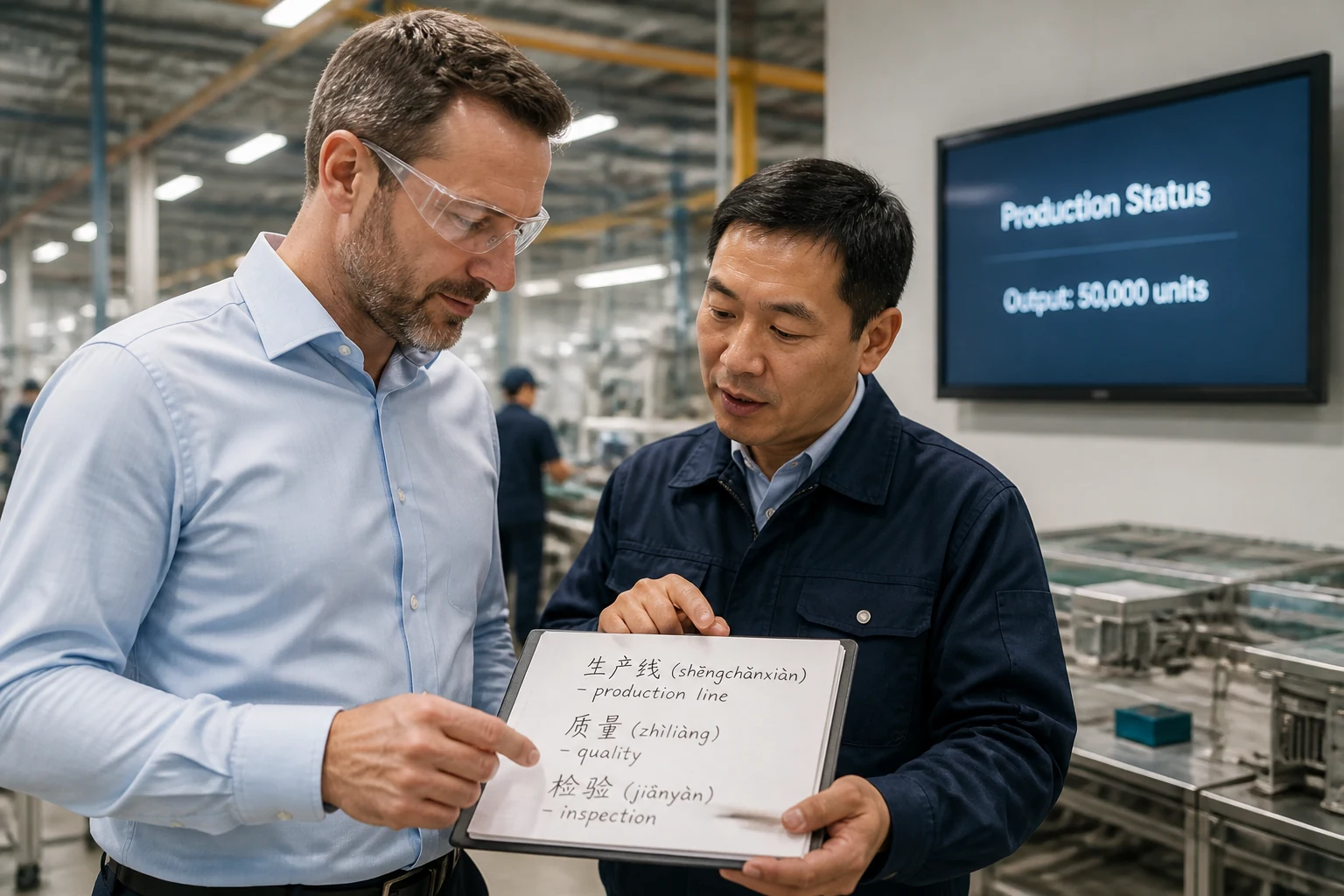
Introduction
Manufacturing runs on precision — and so does the language that surrounds it. A tolerance understood as a guideline instead of a limit, a delivery date you heard as a target instead of a commitment, or a defect rate that reaches you without the batch number it belongs to can turn a smooth production relationship into a costly argument. Yet for most international professionals, factory Mandarin is exactly the vocabulary they never formally learned: textbooks teach greetings and travel, while real production conversations — capacity, inspection, rework, maintenance, logistics — stay out of reach.
This page closes that gap. It gives you the 100 high-frequency manufacturing words you will actually meet when working with Chinese-speaking factories and suppliers, grouped by the four functions that structure your day: production, quality control, equipment and materials, and the supply chain. Every entry includes the Chinese term, pinyin, an English meaning, and guidance on when to use it in a business context.
Vocabulary alone, however, is only half the job. Factory conversations run on patterns: how to open a site visit, how to confirm a delivery schedule, how to raise a quality issue without damaging the relationship, how to report equipment downtime. That is why this page also walks through realistic context sentences for the four most common manufacturing conversations, then shows you how to rehearse them in AI role-play scenarios until the words come out naturally.
By the end of this page, you will know:
- Which manufacturing words matter most — the 100 terms organized into four operational categories, not an alphabetical dump
- How to discuss production, quality, equipment, and supply chain in natural Chinese — with sentences you can adapt to your own orders and numbers
- How manufacturing vocabulary changes by sub-industry — automotive, electronics, textile, machinery, chemical, and food terms that generic word lists skip
- How to practice factory conversations safely — with an AI partner who plays the Chinese supplier or production manager before you risk the real meeting
Module 1: Manufacturing Vocabulary Categories
This module groups 100 high-frequency manufacturing words by the four functions you actually perform: running production, controlling quality, managing equipment and materials, and coordinating the supply chain. Each entry gives the Chinese term, pinyin, an English meaning, and when to use it. The categories follow the flow of a product through a factory — you make it, you check it, you feed it with machines and materials, then you move it — so the words build on each other the way the work does.
Production Vocabulary (30 words)
Production words are the conversation layer of factory work: the terms you use when planning output, tracking schedules, and reporting what the line is doing. Chinese production talk is anchored to numbers and deadlines — a bare 我们在生产 (we are producing) sounds vague, while 这条生产线月产能五万台 (this line produces 50,000 units a month) invites a real discussion. Master this group first because it appears in almost every exchange with a Chinese factory.
| Chinese | Pinyin | English Meaning | When to Use |
|---|---|---|---|
| 生产 | shēng chǎn | production / to produce | Use as the umbrella verb for making goods: 投入生产 (start production), 生产进度 (production progress) |
| 工厂 | gōng chǎng | factory | Use when naming or visiting a facility: 参观工厂 (tour a factory), 新工厂 (new factory) |
| 生产线 | shēng chǎn xiàn | production line | Use when referring to a specific line: 这条生产线 (this line), 增加一条生产线 (add a line) |
| 产能 | chǎn néng | production capacity | Use when discussing how much a plant can make: 月产能五万台 (monthly capacity of 50,000), 产能不够 (not enough capacity) |
| 工艺 | gōng yì | process / technique | Use when discussing how something is made: 生产工艺 (production process), 工艺要求 (process requirements) |
| 制造 | zhì zào | to manufacture / manufacturing | Use for the industry and the act: 制造业 (manufacturing industry), 中国制造 (made in China) |
| 产量 | chǎn liàng | output / production volume | Use when stating how much was produced: 月产量 (monthly output), 提高产量 (increase output) |
| 生产计划 | shēng chǎn jì huà | production plan | Use when planning output: 调整生产计划 (adjust the production plan), 按计划生产 (produce according to plan) |
| 订单 | dìng dān | order | Use for customer or purchase orders: 这批订单 (this batch of orders), 订单量 (order volume) |
| 批量 | pī liàng | batch / lot size | Use when discussing production runs: 小批量 (small batch), 批量生产 (batch production) |
| 工序 | gōng xù | production step / operation | Use when describing the sequence of steps: 下一道工序 (the next step), 工序流程 (process flow) |
| 流水线 | liú shuǐ xiàn | assembly line | Use for continuous-flow assembly: 流水作业 (line work), 流水线工人 (assembly-line worker) |
| 装配 | zhuāng pèi | assembly | Use when parts are put together: 装配车间 (assembly workshop), 装配完成 (assembly complete) |
| 加工 | jiā gōng | machining / processing | Use for transforming raw materials: 精密加工 (precision machining), 来料加工 (processing with supplied materials) |
| 车间 | chē jiān | workshop / shop floor | Use when referring to a physical work area: 生产车间 (production workshop), 装配车间 (assembly workshop) |
| 排产 | pái chǎn | production scheduling | Use when deciding what runs when: 排产计划 (scheduling plan), 重新排产 (reschedule) |
| 产能利用率 | chǎn néng lì yòng lǜ | capacity utilization | Use when discussing efficiency: 产能利用率百分之九十 (90 percent utilization) |
| 交付 | jiāo fù | delivery / to hand over | Use when goods or work are handed over: 按时交付 (deliver on time), 交付日期 (delivery date) |
| 进度 | jìn dù | progress / schedule | Use when checking status: 生产进度 (production progress), 进度如何? (how is progress?) |
| 投产 | tóu chǎn | to go into production | Use when a line or product starts production: 下个月投产 (go into production next month) |
| 试产 | shì chǎn | trial production | Use for a first small run before full output: 试产阶段 (trial-production stage), 试产合格 (trial run passed) |
| 量产 | liàng chǎn | mass production | Use when full-scale output begins: 准备量产 (ready for mass production), 量产时间 (mass-production date) |
| 加班 | jiā bān | overtime | Use when extra hours are needed: 安排加班 (arrange overtime), 加班赶货 (work overtime to rush the order) |
| 瓶颈 | píng jǐng | bottleneck | Use when one step limits the whole line: 生产瓶颈 (production bottleneck), 突破瓶颈 (break the bottleneck) |
| 生产任务 | shēng chǎn rèn wù | production task | Use when assigning work to a line or team: 完成生产任务 (complete the production task) |
| 半成品 | bàn chéng pǐn | semi-finished product | Use for goods partway through the process: 半成品库存 (semi-finished inventory) |
| 成品 | chéng pǐn | finished product | Use for goods ready to ship: 成品仓库 (finished-goods warehouse), 成品率 (yield rate) |
| 出货 | chū huò | shipment / to ship out | Use when goods leave the factory: 明天出货 (ship tomorrow), 出货计划 (shipment plan) |
| 产能不足 | chǎn néng bù zú | insufficient capacity | Use when a plant cannot meet demand: 由于产能不足 (due to insufficient capacity) |
| 生产周期 | shēng chǎn zhōu qī | production cycle | Use when discussing lead time from start to finish: 缩短生产周期 (shorten the production cycle) |
Quality Control Vocabulary (25 words)
Quality conversations are the most relationship-sensitive part of factory communication: a defect you report well gets fixed, and a defect you report clumsily damages trust. Chinese quality language is precise about degree — whether a part is 合格 (within standard), 不合格 (not up to standard), or merely has a 缺陷 (defect) that can be tolerated changes who pays and what happens next. This group covers inspection, standards, defects, and corrective action.
| Chinese | Pinyin | English Meaning | When to Use |
|---|---|---|---|
| 质量 | zhì liàng | quality | Use as the umbrella term: 质量问题 (quality problem), 保证质量 (ensure quality) |
| 检验 | jiǎn yàn | inspection / to inspect | Use for the act of checking: 检验报告 (inspection report), 逐批检验 (inspect batch by batch) |
| 标准 | biāo zhǔn | standard | Use when a benchmark exists: 质量标准 (quality standard), 符合标准 (meet the standard) |
| 合格 | hé gé | qualified / up to standard | Use when goods pass: 合格产品 (qualified product), 检验合格 (passed inspection) |
| 不合格 | bù hé gé | unqualified / not up to standard | Use when goods fail: 不合格品 (non-conforming product), 判定不合格 (judged non-conforming) |
| 不良品 | bù liáng pǐn | defective product | Use for units that fail quality checks: 退回不良品 (return defective products) |
| 质检 | zhì jiǎn | quality inspection | Use as the short working term: 质检部门 (QC department), 通过质检 (pass QC) |
| 合格率 | hé gé lǜ | pass rate / qualification rate | Use when quoting a percentage: 合格率达到百分之九十八 (pass rate reaches 98 percent) |
| 不良率 | bù liáng lǜ | defect rate | Use when tracking defects: 不良率超标 (defect rate over the limit), 降低不良率 (reduce the defect rate) |
| 抽检 | chōu jiǎn | sampling inspection | Use when only some units are checked: 随机抽检 (random sampling inspection) |
| 全检 | quán jiǎn | full inspection / 100% inspection | Use when every unit is checked: 全部全检 (inspect all units), 全检成本高 (full inspection is costly) |
| 返工 | fǎn gōng | rework | Use when units are repaired to pass: 返工费用 (rework cost), 需要返工 (needs rework) |
| 报废 | bào fèi | scrap / to discard | Use when units cannot be salvaged: 整批报废 (the whole batch is scrapped), 报废率 (scrap rate) |
| 缺陷 | quē xiàn | defect | Use for a specific flaw: 严重缺陷 (major defect), 外观缺陷 (cosmetic defect) |
| 公差 | gōng chā | tolerance | Use for allowable measurement range: 公差范围 (tolerance range), 超出公差 (out of tolerance) |
| 规格 | guī gé | specification | Use for required dimensions or properties: 产品规格 (product specification), 不符合规格 (does not meet spec) |
| 样品 | yàng pǐn | sample | Use when a physical sample is shared: 确认样品 (approve the sample), 样品间 (sample room) |
| 认证 | rèn zhèng | certification | Use for formal approvals: ISO 认证 (ISO certification), 认证证书 (certificate) |
| 质量保证 | zhì liàng bǎo zhèng | quality assurance | Use for the system, not a single check: 质量保证体系 (QA system) |
| 质量控制 | zhì liàng kòng zhì | quality control | Use for the ongoing process: 加强质量控制 (strengthen quality control) |
| 退换货 | tuì huàn huò | returns and exchanges | Use when goods are sent back: 支持退换货 (returns and exchanges supported) |
| 索赔 | suǒ péi | claim for compensation | Use when a defect has a cost: 提出索赔 (file a claim), 索赔金额 (claim amount) |
| 复检 | fù jiǎn | re-inspection | Use when failed goods are checked again: 申请复检 (request a re-inspection) |
| 整改 | zhěng gǎi | rectification / corrective action | Use when a process must be fixed: 整改报告 (corrective-action report), 限期整改 (rectify within a deadline) |
| 验收 | yàn shōu | acceptance inspection | Use when the buyer formally accepts goods: 验收合格 (pass acceptance), 验收后付款 (pay after acceptance) |
Equipment and Materials Vocabulary (25 words)
Equipment and materials are what make production physically possible, and Chinese factory teams discuss them with the vocabulary of uptime and wear. A machine does not simply "break" — it has a 故障 (fault), it causes 停机 (downtime), and it needs 维修 (repair) or 保养 (servicing). These 25 terms cover machines, tools, materials, and the maintenance language you need to keep a line running and to sound like someone who understands the shop floor.
| Chinese | Pinyin | English Meaning | When to Use |
|---|---|---|---|
| 设备 | shè bèi | equipment | Use as the umbrella term for machinery: 生产设备 (production equipment), 设备清单 (equipment list) |
| 原材料 | yuán cái liào | raw materials | Use for inputs before processing: 原材料成本 (raw-material cost), 采购原材料 (purchase raw materials) |
| 零件 | líng jiàn | parts | Use for individual components: 更换零件 (replace a part), 进口零件 (imported parts) |
| 模具 | mú jù | mold / die | Use for forming tools: 开模具 (make a mold), 模具费用 (mold cost) |
| 维护 | wéi hù | maintenance | Use for keeping equipment in order: 设备维护 (equipment maintenance), 定期维护 (regular maintenance) |
| 机器 | jī qì | machine | Use for a single machine: 三号机器 (machine No. 3), 机器故障 (machine fault) |
| 配件 | pèi jiàn | accessories / fittings | Use for attached or replacement items: 原厂配件 (original accessories), 配件供应 (accessory supply) |
| 零部件 | líng bù jiàn | components | Use for the collective set of parts: 关键零部件 (key components), 零部件供应商 (component supplier) |
| 材料 | cái liào | material | Use for any input material: 包装材料 (packaging material), 材料清单 (bill of materials) |
| 工具 | gōng jù | tool | Use for hand and power tools: 专用工具 (special tools), 工具箱 (toolbox) |
| 夹具 | jiā jù | fixture / jig | Use for work-holding devices: 焊接夹具 (welding fixture), 设计夹具 (design a fixture) |
| 保养 | bǎo yǎng | servicing / upkeep | Use for routine preventive care: 定期保养 (routine servicing), 保养记录 (service record) |
| 维修 | wéi xiū | repair | Use when something is fixed after failure: 维修团队 (repair team), 维修费用 (repair cost) |
| 故障 | gù zhàng | breakdown / fault | Use for equipment failing: 出现故障 (a fault occurred), 排除故障 (clear the fault) |
| 停机 | tíng jī | downtime / to stop the machine | Use for a line or machine not running: 意外停机 (unplanned downtime), 停机时间 (downtime) |
| 调试 | tiáo shì | to commission / set up | Use when equipment is adjusted to work correctly: 设备调试 (commission the equipment), 调试完成 (commissioning complete) |
| 校准 | jiào zhǔn | calibration | Use for measurement accuracy: 仪器校准 (instrument calibration), 校准证书 (calibration certificate) |
| 损耗 | sǔn hào | loss / wear and tear | Use for material or efficiency loss: 材料损耗 (material loss), 降低损耗 (reduce loss) |
| 备件 | bèi jiàn | spare parts | Use for held-back replacement parts: 备件库存 (spare-parts inventory), 订购备件 (order spare parts) |
| 耗材 | hào cái | consumables | Use for items used up in production: 耗材清单 (consumables list), 采购耗材 (buy consumables) |
| 材质 | cái zhì | material / material quality | Use when specifying what something is made of: 不锈钢材质 (stainless-steel material), 材质证明 (material certificate) |
| 钢材 | gāng cái | steel | Use for steel as an input: 钢材价格 (steel price), 钢材供应商 (steel supplier) |
| 塑料 | sù liào | plastic | Use for plastic as an input: 塑料件 (plastic part), 工程塑料 (engineering plastic) |
| 润滑油 | rùn huá yóu | lubricant | Use for machine oils: 加润滑油 (add lubricant), 更换润滑油 (change the lubricant) |
| 使用寿命 | shǐ yòng shòu mìng | service life | Use for how long equipment lasts: 延长使用寿命 (extend the service life) |
Supply Chain Vocabulary (20 words)
Supply chain words connect the factory to the world outside it: suppliers, orders, inventories, and the movement of goods. Chinese logistics language is specific about where a shipment is — 发货 (dispatched), 运输 (in transit), 到货 (arrived), or 清关 (clearing customs) — and each stage has its own vocabulary. These 20 terms cover purchasing, stock, shipping, and the trade paperwork that surrounds cross-border manufacturing.
| Chinese | Pinyin | English Meaning | When to Use |
|---|---|---|---|
| 供应链 | gōng yìng liàn | supply chain | Use for the whole system: 供应链管理 (supply chain management), 供应链中断 (supply chain disruption) |
| 采购 | cǎi gòu | procurement / purchasing | Use for buying inputs: 采购部门 (procurement department), 集中采购 (centralized purchasing) |
| 库存 | kù cún | inventory / stock | Use for goods held: 库存水平 (inventory level), 库存积压 (excess inventory) |
| 交货期 | jiāo huò qī | delivery time / lead time | Use when agreeing a schedule: 交货期是多长? (how long is the lead time?), 缩短交货期 (shorten the lead time) |
| 物流 | wù liú | logistics | Use for the movement of goods: 物流成本 (logistics cost), 第三方物流 (third-party logistics) |
| 供应商 | gōng yìng shāng | supplier | Use when naming a source: 主要供应商 (main supplier), 供应商评估 (supplier evaluation) |
| 采购单 | cǎi gòu dān | purchase order | Use for the formal order document: 下达采购单 (issue a purchase order), 采购单号 (PO number) |
| 仓储 | cāng chǔ | warehousing | Use for storage operations: 仓储管理 (warehouse management), 仓储费用 (storage cost) |
| 运输 | yùn shū | transportation | Use for moving goods: 运输方式 (mode of transport), 运输时间 (transit time) |
| 发货 | fā huò | to ship / dispatch | Use from the seller's side: 已发货 (has shipped), 发货通知 (shipment notice) |
| 收货 | shōu huò | to receive goods | Use from the buyer's side: 确认收货 (confirm receipt), 收货地址 (delivery address) |
| 到货 | dào huò | arrival of goods | Use when goods reach the destination: 预计到货 (expected arrival), 到货时间 (arrival time) |
| 缺货 | quē huò | out of stock | Use when stock runs out: 暂时缺货 (temporarily out of stock), 缺货风险 (stockout risk) |
| 补货 | bǔ huò | restocking | Use when stock is refilled: 及时补货 (restock promptly), 补货周期 (restocking cycle) |
| 盘点 | pán diǎn | inventory count | Use for physical stock checks: 月度盘点 (monthly count), 盘点差异 (count discrepancy) |
| 周转率 | zhōu zhuǎn lǜ | turnover rate | Use for how fast stock moves: 库存周转率 (inventory turnover rate), 提高周转率 (improve turnover) |
| 报关 | bào guān | customs declaration | Use when goods cross a border: 报关文件 (customs documents), 报关流程 (customs procedure) |
| 清关 | qīng guān | customs clearance | Use when goods are released by customs: 清关延误 (customs delay), 顺利清关 (cleared smoothly) |
| 供货 | gōng huò | to supply goods | Use for a supplier's ongoing delivery: 稳定供货 (stable supply), 供货能力 (supply capacity) |
| 运费 | yùn fèi | freight / shipping cost | Use when quoting carriage: 运费谁承担? (who pays the freight?), 运费报价 (freight quote) |
Module 2: Manufacturing Context Examples
Vocabulary gives you the building blocks, but factory conversations happen in sentences — opening a site visit, confirming a schedule, escalating a defect, reporting a breakdown. Each example below includes the Chinese sentence, pinyin, an English translation, and the manufacturing moment it belongs to. These are patterns you can adapt directly with your own orders, lines, and dates.
Factory Visit Language (工厂参观用语)
1. 欢迎参观我们的工厂,我先带您看一下生产线。 - Pinyin: Huānyíng cānguān wǒmen de gōngchǎng, wǒ xiān dài nín kàn yīxià shēngchǎnxiàn. - English: Welcome to our factory — let me first show you the production line. - When to use: Opening a factory tour; 参观 (visit) and 生产线 (production line) set a professional, welcoming tone.
2. 这条生产线的月产能是五万台。 - Pinyin: Zhè tiáo shēngchǎnxiàn de yuè chǎnnéng shì wǔ wàn tái. - English: This production line has a monthly capacity of 50,000 units. - When to use: Stating capacity during a site visit; note the unit 台 for machines or products and 万 for the number.
3. 请戴好安全帽,车间里禁止拍照。 - Pinyin: Qǐng dài hǎo ānquán mào, chējiān lǐ jìnzhǐ pāizhào. - English: Please wear your safety helmet; photography is not allowed on the shop floor. - When to use: Facility safety instructions in Chinese; 车间 (workshop) is the standard word for the shop floor.
Production Planning Discussion (生产计划讨论)
4. 这批订单的交货期是什么时候? - Pinyin: Zhè pī dìngdān de jiāohuòqī shì shénme shíhou? - English: What is the delivery date for this batch of orders? - When to use: Confirming a schedule at the start of planning; 交货期 is the anchor for every production timeline.
5. 如果产能不够,我们可以安排加班,或者分成两班生产。 - Pinyin: Rúguǒ chǎnnéng bù gòu, wǒmen kěyǐ ānpái jiābān, huòzhě fēn chéng liǎng bān shēngchǎn. - English: If capacity is not enough, we can arrange overtime or run two shifts. - When to use: Proposing solutions to a capacity gap; 产能 (capacity) and 加班 (overtime) are core planning vocabulary.
6. 我们已经按新的排产计划调整了生产线。 - Pinyin: Wǒmen yǐjīng àn xīn de páichǎn jìhuà tiáozhěng le shēngchǎnxiàn. - English: We have already adjusted the production line according to the new scheduling plan. - When to use: Reporting a scheduling change; 排产 (production scheduling) signals operational control.
Quality Issue Handling (质量问题处理)
7. 这批货的不良率超过了标准,需要全额返工。 - Pinyin: Zhè pī huò de bùliánglǜ chāoguò le biāozhǔn, xūyào quán'é fǎngōng. - English: The defect rate for this batch exceeds the standard and requires full rework. - When to use: Escalating a quality problem with facts; cite the 不良率 (defect rate) against the 标准 (standard).
8. 我们会对不合格的产品做全检,合格以后再发货。 - Pinyin: Wǒmen huì duì bù hégé de chǎnpǐn zuò quánjiǎn, hégé yǐhòu zài fāhuò. - English: We will run a full inspection on the non-conforming products and ship only after they pass. - When to use: Explaining corrective action; 不合格 (non-conforming) and 全检 (full inspection) show process discipline.
9. 请提供详细的检验报告,我们需要确认根本原因。 - Pinyin: Qǐng tígōng xiángxì de jiǎnyàn bàogào, wǒmen xūyào quèrèn gēnběn yuányīn. - English: Please provide a detailed inspection report — we need to confirm the root cause. - When to use: Requesting documentation before accepting a fix; 检验报告 (inspection report) is standard evidence in Chinese QC.
Equipment Maintenance Communication (设备维护沟通)
10. 三号机器出了故障,生产线已经停机了。 - Pinyin: Sān hào jīqì chū le gùzhàng, shēngchǎnxiàn yǐjīng tíngjī le. - English: Machine No. 3 has broken down and the production line has stopped. - When to use: Reporting an equipment fault quickly; 故障 (fault) and 停机 (shutdown) are the two key status words.
11. 我们每周做一次保养,设备的使用寿命会更长。 - Pinyin: Wǒmen měi zhōu zuò yī cì bǎoyǎng, shèbèi de shǐyòng shòumìng huì gèng cháng. - English: We service the equipment once a week, which extends its service life. - When to use: Explaining a preventive maintenance routine; 保养 (servicing) versus 维修 (repair) is a useful distinction.
12. 维修团队正在调试,预计两小时内恢复生产。 - Pinyin: Wéixiū tuánduì zhèngzài tiáoshì, yùjì liǎng xiǎoshí nèi huīfù shēngchǎn. - English: The repair team is commissioning the machine; production is expected to resume within two hours. - When to use: Giving a recovery estimate during downtime; 调试 (commissioning) and 恢复生产 (resume production) are precise.
The gap between recognizing a word and producing a natural sentence is where most learners stall. Reading these patterns helps, but the real breakthrough comes when you practice responding in a simulated factory conversation — which is what the practice scenarios below are designed for.
Module 3: Practice Scenarios
Knowing the word for a defect rate is not the same as raising a quality problem in real time with a supplier who is proud of their factory. These four scenarios cover the manufacturing conversations that recur across almost every relationship with a Chinese factory or supplier. Read the goal of each one, then practice them with the AI role-play method described after the list — the fastest way to move this vocabulary from recognition to recall.
Scenario 1: Factory Visit Dialogue (工厂参观对话)
- Situation: You are visiting a Chinese factory for the first time. Your host shows you the production lines, the workshop, and the quality-control station, and asks what you think.
- What you will practice: Asking about 产能 (capacity) and 生产线 (production lines), confirming 工艺 (processes), asking where 质检 (quality inspection) happens, and closing the visit with clear next steps.
- Key vocabulary: 工厂 (gōng chǎng), 生产线 (shēng chǎn xiàn), 产能 (chǎn néng), 车间 (chē jiān), 质检 (zhì jiǎn)
Scenario 2: Quality Issue Discussion (质量问题讨论)
- Situation: A shipment arrived with defects. You need to raise the problem with the Chinese supplier, establish the facts, and agree on rework or a claim without damaging the relationship.
- What you will practice: Presenting the 不良率 (defect rate) and the 规格 (specification) it violates, requesting a 检验报告 (inspection report), proposing 全检 (full inspection) or 返工 (rework), and negotiating a 整改 (corrective action) deadline.
- Key vocabulary: 不良率 (bù liáng lǜ), 不合格 (bù hé gé), 检验 (jiǎn yàn), 返工 (fǎn gōng), 整改 (zhěng gǎi)
Scenario 3: Production Planning Meeting (生产计划会议)
- Situation: You are planning next month's output with the Chinese production team. Demand is rising, but the line is already close to full capacity.
- What you will practice: Confirming the 交货期 (delivery time), discussing 产能 (capacity) limits, weighing 加班 (overtime) against adding a shift, and agreeing on a realistic 生产计划 (production plan).
- Key vocabulary: 生产计划 (shēng chǎn jì huà), 产能 (chǎn néng), 交货期 (jiāo huò qī), 排产 (pái chǎn), 加班 (jiā bān)
Scenario 4: Equipment Problem Resolution (设备问题处理)
- Situation: A key machine has broken down mid-order and the line has stopped. You are talking with the factory's maintenance lead about the fault and the recovery plan.
- What you will practice: Understanding the 故障 (fault), asking about 停机 (downtime), discussing 维修 (repair) versus 保养 (servicing), and confirming when production will 恢复 (resume).
- Key vocabulary: 设备 (shè bèi), 故障 (gù zhàng), 停机 (tíng jī), 维修 (wéi xiū), 调试 (tiáo shì)
How to Practice These Scenarios with AI Role-Play
Reading scenario goals only gets you so far — the point is to rehearse the conversation out loud under the same time pressure as a real factory meeting. This is exactly what the product's AI role-play was built for: you speak, the AI plays the Chinese factory manager or supplier, and the conversation moves in real time. If you stumble on a quality term or blank on a capacity figure, restart the scenario and try again — as many times as you need, with no supplier watching.
Example scenario run — raising a quality issue:
- Your role: An overseas sourcing manager reporting a defect problem to a Chinese supplier
- AI role: A Chinese factory quality manager who wants to understand the problem and protect the relationship
- Goal: State the 不良率 and the affected 批次, request a 检验报告, agree on 全检 or 返工, and set a 整改 deadline using the vocabulary above
- Difficulty: Beginner to Lower-Intermediate
- Estimated time: 3–5 minutes
How the AI evaluates you: After each attempt, you receive feedback across four dimensions:
- Accuracy: Did you use the right manufacturing term — 产能 vs 产量, 保养 vs 维修, 不合格 vs 不良品?
- Clarity: Did you state quantities, batch numbers, and deadlines so a Chinese listener could act on them?
- Professional Tone: Were you firm about the problem but respectful of the supplier's face when proposing fixes?
- Cultural Appropriateness: Did you respect how Chinese factory teams frame quality — evidence first, relationship throughout?
CTA Button: Practice Manufacturing Vocabulary with AI
Module 4: Industry-Specific Terms
General manufacturing vocabulary carries you through most factory conversations, but sub-industries and standards bodies add their own layers. If you work in automotive, electronics, textiles, machinery, chemicals, or food, these specialized terms will appear in your specifications, certificates, and contracts. Each entry includes Chinese, pinyin, an English meaning, and when to use it.
Manufacturing-Specific Terms
| Chinese | Pinyin | English Meaning | When to Use |
|---|---|---|---|
| 代工 | dài gōng | OEM / contract manufacturing | Use when a factory makes goods for another brand: 代工生产 (contract manufacturing), 找工厂代工 (find a factory to manufacture for you) |
| 贴牌 | tiē pái | private label / OEM branding | Use when goods carry the buyer's brand: 贴牌生产 (private-label production), 贴牌产品 (private-label product) |
| 自有品牌 | zì yǒu pǐn pái | own brand | Use for a manufacturer's own branded goods: 打造自有品牌 (build an own brand) |
| 来料加工 | lái liào jiā gōng | processing with supplied materials | Use when the buyer provides materials to the factory: 来料加工订单 (processing-on-supplied-materials order) |
| 精益生产 | jīng yì shēng chǎn | lean manufacturing | Use when discussing waste reduction methods: 推行精益生产 (implement lean manufacturing) |
| 六西格玛 | liù xī gé mǎ | Six Sigma | Use when discussing a quality-management methodology: 六西格玛培训 (Six Sigma training) |
Manufacturing Types Vocabulary
| Chinese | Pinyin | English Meaning | When to Use |
|---|---|---|---|
| 汽车制造 | qì chē zhì zào | automotive manufacturing | Use for the vehicle industry: 汽车零部件 (auto parts), 汽车制造厂 (car factory) |
| 电子制造 | diàn zǐ zhì zào | electronics manufacturing | Use for electronics production: 电子制造服务 (electronics manufacturing services) |
| 纺织服装 | fǎng zhī fú zhuāng | textile and apparel | Use for fabric and clothing production: 纺织服装行业 (textile and apparel industry) |
| 机械制造 | jī xiè zhì zào | machinery manufacturing | Use for equipment and machine production: 机械制造企业 (machinery manufacturer) |
| 化工 | huà gōng | chemical industry | Use for chemical production: 化工产品 (chemical products), 化工原料 (chemical raw materials) |
| 食品加工 | shí pǐn jiā gōng | food processing | Use for food manufacturing: 食品加工厂 (food-processing plant), 食品添加剂 (food additives) |
Industry Standard Expressions
| Chinese | Pinyin | English Meaning | When to Use |
|---|---|---|---|
| 国标 | guó biāo | national standard (GB) | Use when Chinese national standards apply: 符合国标 (meets the national standard), 国标认证 (GB certification) |
| 行业标准 | háng yè biāo zhǔn | industry standard | Use for sector-specific rules: 达到行业标准 (reach the industry standard) |
| ISO 认证 | ISO rèn zhèng | ISO certification | Use for international quality certification: 通过 ISO 认证 (passed ISO certification) |
| 出厂检验 | chū chǎng jiǎn yàn | factory inspection / pre-shipment inspection | Use for the check before goods leave: 出厂检验报告 (factory inspection report) |
| 合格证 | hé gé zhèng | certificate of conformity | Use for the paperwork that accompanies goods: 随货附合格证 (certificate of conformity included with goods) |
| 质保期 | zhì bǎo qī | warranty period | Use when agreeing after-sales coverage: 质保期一年 (one-year warranty period), 质保期内 (within the warranty period) |
Practice Factory Conversations with AI Role-Play
Vocabulary lists and sample sentences build knowledge; only practice builds fluency. Factory Chinese is uniquely hard to rehearse with a human partner — asking a real supplier to sit through your halting attempts at quality language is not practical, and raising a defect problem for the first time under pressure is exactly when words disappear. That is the gap AI role-play fills: a realistic manufacturing conversation with a patient AI counterpart and structured feedback on every attempt.
Practice Manufacturing Vocabulary with AI
Try the quality-issue scenario first: report a defect rate that exceeds the standard, request an inspection report, agree on full inspection or rework, and set a corrective-action deadline — then review the AI's feedback on your accuracy, clarity, tone, and cultural appropriateness. Repeat the scenario until the vocabulary flows without translation in your head. By the time the real supplier call happens, you will already have handled it several times.
FAQ
Start with the words that appear in every factory conversation: 生产 (shēng chǎn — production), 工厂 (gōng chǎng — factory), 质量 (zhì liàng — quality), 检验 (jiǎn yàn — inspection), 交货期 (jiāo huò qī — delivery time), and 设备 (shè bèi — equipment). From there, add the category that matches your role — production if you plan output, quality control if you handle defects, equipment and materials if you manage the shop floor, or supply chain if you coordinate suppliers and shipping. The 100 words on this page are organized exactly that way, so you can learn the group you need first. For a broader foundation across all business situations, see our complete business Chinese vocabulary list.
State the fact, then the impact, then the ask. Report the numbers directly — 三号机器出了故障,生产线已经停机了 (machine No. 3 broke down and the line has stopped) — and follow with a recovery plan: 预计两小时内恢复生产 (production is expected to resume within two hours). For capacity problems, name the gap and the fix together: 如果产能不够,我们可以安排加班 (if capacity is not enough, we can arrange overtime). Chinese production teams respond best to a clear problem statement plus options, not to open-ended worry. To go deeper on production and factory language, see our guide to business Chinese for manufacturing.
Lead with evidence, not adjectives. Say the 不良率 (bù liáng lǜ — defect rate) and the 规格 (guī gé — specification) it violates, then ask for a 检验报告 (jiǎn yàn bào gào — inspection report) and propose a fix — 全检 (quán jiǎn — full inspection) or 返工 (fǎn gōng — rework). Distinguish 不合格 (bù hé gé — not up to standard, a judgment against a standard) from 不良品 (bù liáng pǐn — defective products, the individual units). A precise quality complaint reads as professional; a vague one reads as an accusation and puts the supplier on the defensive.
Prepare a short set of questions and let your host lead. Common openings include 这条生产线的月产能是多少?(what is the monthly capacity of this line?) and 质检在哪个环节进行?(where does quality inspection happen?). Respect the facility rules — 请戴好安全帽,车间里禁止拍照 (please wear your safety helmet; photography is not allowed on the shop floor) — and close the visit by confirming next steps clearly: 我们回去确认样品以后下单 (we will place the order after confirming the sample). For the full set of factory phrases, see business Chinese for manufacturing.
Use the standard sequence for a breakdown — report the 故障 (gù zhàng — fault), acknowledge the 停机 (tíng jī — downtime), and give an estimate for 恢复生产 (huī fù shēng chǎn — resuming production). Keep 保养 (bǎo yǎng — routine servicing) separate from 维修 (wéi xiū — repair after failure): asking about the 保养周期 (servicing cycle) shows you manage operations, not just react to failures. And for critical parts, always confirm the 材质 (cái zhì — material grade) and the 使用寿命 (shǐ yòng shòu mìng — service life) in writing rather than trusting a verbal assurance.
Yes. AI role-play lets you rehearse factory conversations — a site visit, a quality dispute, a production planning meeting, an equipment breakdown — with an AI partner who plays the Chinese supplier or production manager, then gives feedback on accuracy, clarity, professional tone, and cultural appropriateness. It is the safest place to make factory-language mistakes: restart the scenario as many times as you need before the real supplier call. Start with the manufacturing role-play scenarios and build from there. If you also manage suppliers and shipping, the supply chain learning path extends the same vocabulary to logistics and procurement.